HISTORY OF MEDICINE
The article examines the life and work of Nikolai Vasilyevich Sklifosovsky (1836–1904), an outstanding Russian surgeon, professor, academician, pioneer of military field surgery, and scientific innovator. It traces the key stages of his career: from receiving his Doctor of Medicine degree in 1863 to heading the Imperial Clinical Institute of Grand Duchess Elena Pavlovna in 1893. Special attention is given to his contributions to military field surgery and abdominal surgery, as well as his introduction of antiseptic and aseptic techniques, which significantly reduced postoperative mortality in Russia. The article also highlights the international recognition he received as an honorary member of leading medical societies in Europe and Russia. Sklifosovsky’s work not only transformed Russian surgery but also helped turn medicine from a craft into a science, laying a solid foundation for the training of future generations of physicians.
SURGERY
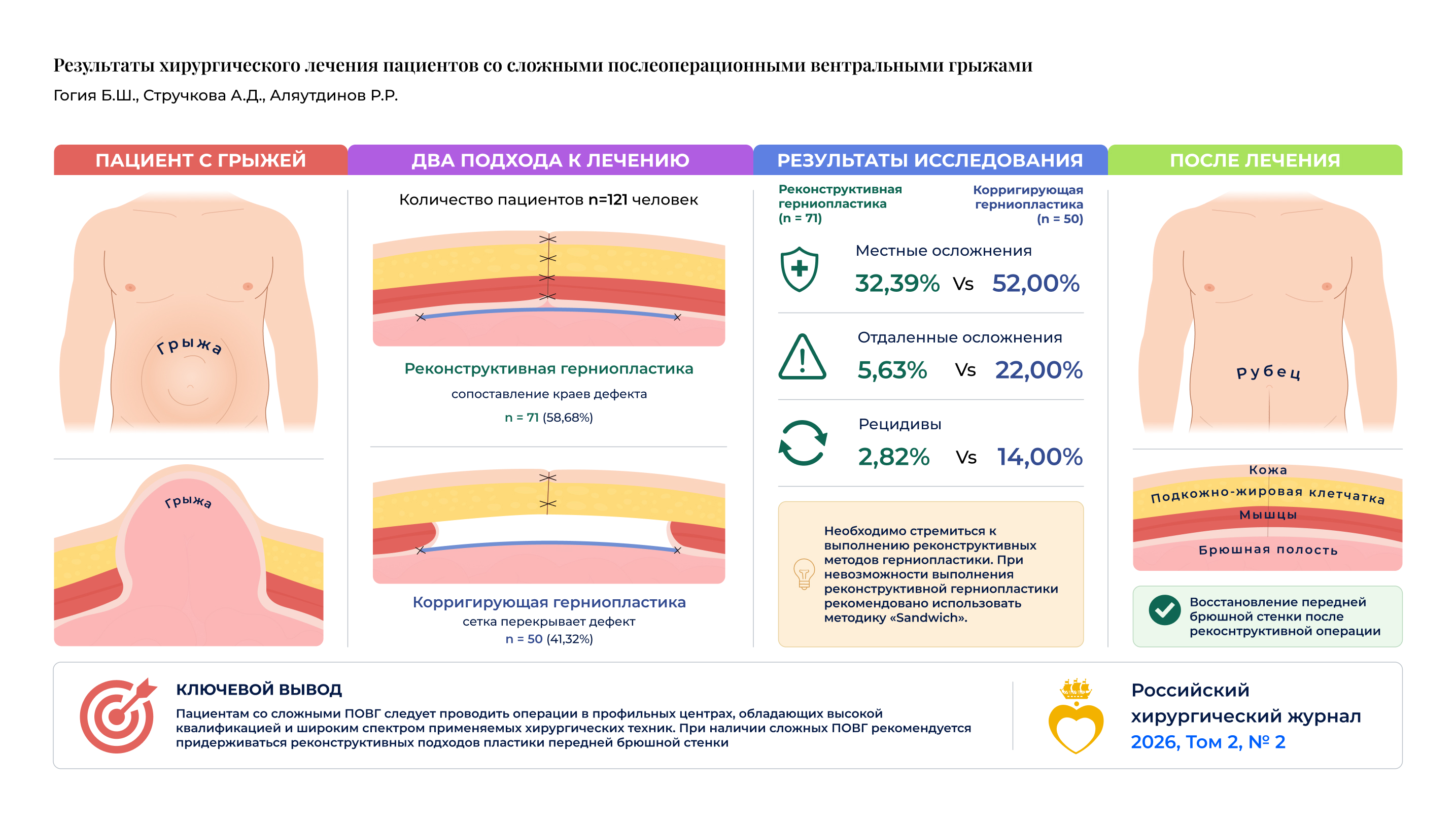
Research objective to assess the surgical treatment outcomes of complex incisional hernias of moderate and major severity classes meeting the criteria established by Slater et al. in the early and long-term postoperative period. A total of 121 patients with complex incisional hernias (hernia ≥10 cm in width) following surgical treatment at the A.V. Vishnevsky National Medical Research Center of Surgery in the period from 2015 to 2022 were enrolled in the study. Hernias meeting the criteria established by N.J. Slater et al. (2014) were considered complex. In 71 (58.68 %) cases were used reconstructive repair (midline fascial approximation). In 50 (41.32 %) cases, due to the impossibility of bringing the edges of the hernial orifice together, were used bridged repair (mesh is placed as a bridge). Common general complications in the early postoperative period were observed in 48 (40.5 %) patients, including 38 (31.4 %) cases of seroma, 5 (4.13 %) cases of skin dehiscence, 3 (2.48 %) cases of wound suppuration, 2 (1.65 %) cases of skin necrosis, and 1 (0.83 %) case of bleeding from the mesh placement. The mean follow-up was 3.12±0.15 years (from 1 to 7 years) after the surgery. Hernia recurrence was recorded in 9 (7.44 %) patients, ligature fistula of the anterior abdominal wall – in 3 (2.48 %) patients, pseudocyst of the anterior abdominal wall – in 3 (2.48 %) cases. Reconstructive repair was superior to bridged repair in terms of lower rate of local wound complications (32.39 % versus 52.00 %, p = 0.048) and long-term complications (5.63 % versus 22.00 %, p = 0.016), the last included hernia recurrence (2.82 % vs. 14.00 %, p = 0.021). The “Sandwich” bridging technique demonstrated optimal outcomes in terms of hernia recurrence. Reconstructive repair for complex incisional hernias have shown better outcomes compared to bridged repair. The “Sandwich” bridging repair is recommended, if there is no opportunity to perform reconstructive repair.
The ongoing pursuit of minimally invasive approaches and rapid rehabilitation in modern surgery has led to the increasing adoption of high-tech treatment modalities. However, the implementation of minimally invasive surgical interventions is constrained by a technical difficulty and lengthy learning curve. Simulation-based technologies can minimize risks to patients and shorten the learning trajectory, yet they require the development of effective educational strategies. Objective to present the experience of designing and implementing continuing professional development courses using combined simulation methodologies, specifically Dry-Lab and Wet-Lab approaches. The training is structured according to a stepwise learning principle, progressing from Dry-Lab to Wet-Lab technologies. All training programs have been developed in compliance with the principles of humane animal treatment and current legislation. Between 2020 and 2024, a total of 36 courses employing combined simulation methodologies were organized, with durations ranging from 18 to 36 academic hours. The advantages of training using combined simulation methodologies are described, along with the organizational challenges encountered. Combined simulation methodologies enable the safe and effective practice of the full cycle of surgical interventions, thereby shortening the learning curve. However, the implementation of such training programs requires a properly equipped facility, trained personnel, and strict adherence to regulatory, legal, and bioethical standards.
ONCOLOGY
Minimally invasive sphincter-preserving surgery for rectal cancer is a promising approach in modern oncological surgical care, helping to preserve the quality of life of patients with rectal cancer by preserving the structures of the pelvic floor and the sphincter apparatus of the rectum. One of the modern surgical techniques is the en-bloc pelvic floor muscle resection technique, which allows for the radical removal of rectal tumors with minimal damage to surrounding tissues and structures and preserves the functionality of the pelvic organs. The clinical case presented in this article illustrates the effectiveness and safety of this surgical technique, as well as the indications and contrain-dications for its use.
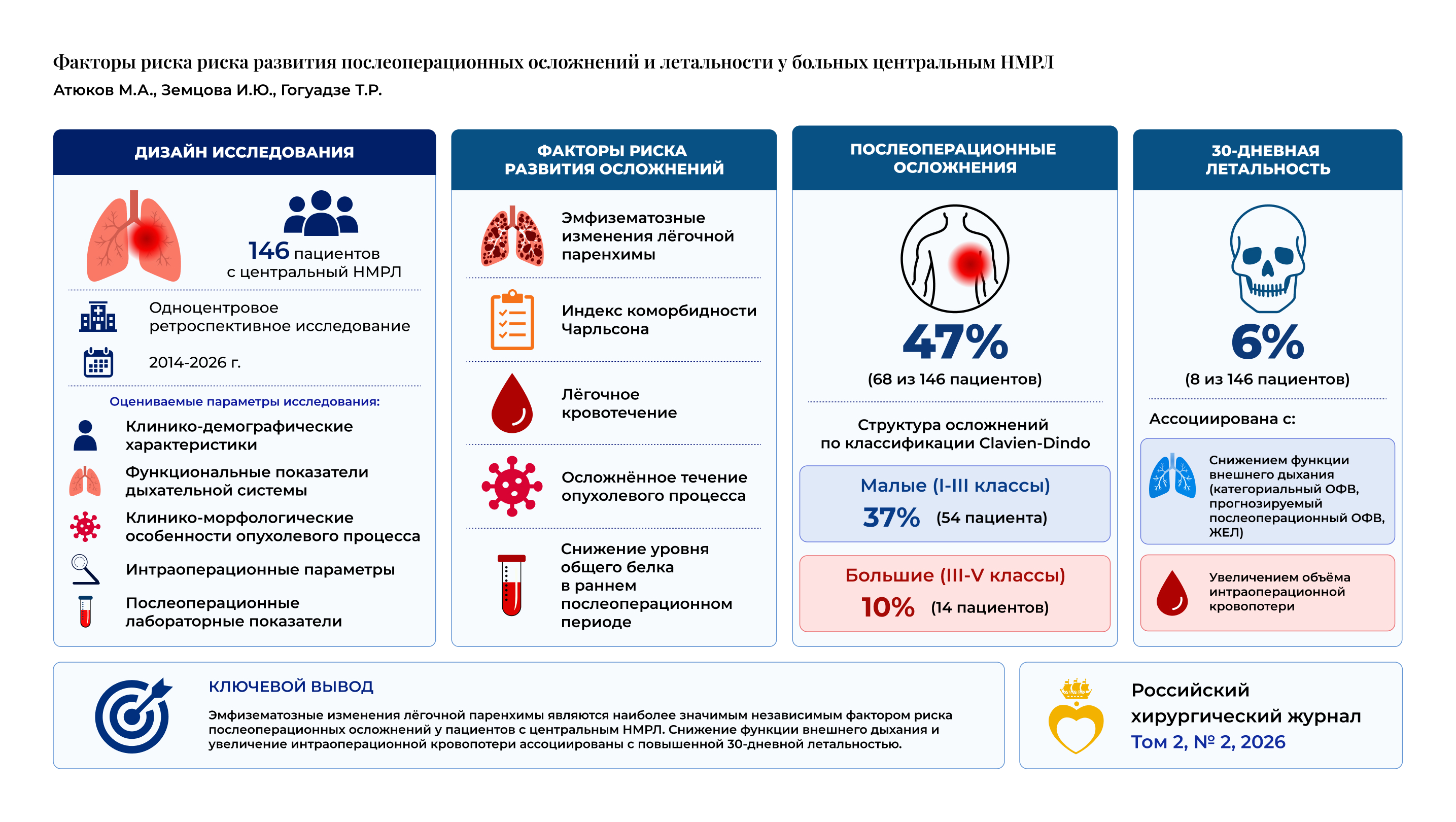
Objective – to identify risk factors for postoperative complications and 30-day mortality in patients with central non-small cell lung cancer undergoing anatomical lung resections. This retrospective single-center study included 146 patients with central non-small cell lung cancer selected from a cohort of 509 patients who underwent anatomical lung resections between 2014 and 2025. Tumors were classified as central when located in the main, intermediate, lobar, or segmental bronchi. Clinical and demographic characteristics, pulmonary function parameters, clinicopathological tu-mor features, intraoperative variables, and postoperative laboratory data were analyzed. Postoperative complications were classified according to the modified Clavien – Dindo classification. Univariate and multivariate logistic regression analyses were performed to identify risk factors. Postoperative complications occurred in 68 of 146 patients (47 %). Minor complications (Clavien – Dindo grades I–IIIa) were observed in 54 patients (37 %), while major complications (grades IIIb–V) occurred in 14 patients (10 %). The 30-day mortality rate was 6 % (eight cases). In univariate analysis, the risk of postoperative complications was associated with the Charlson Comorbidity Index (OR 1.17; 95 % CI 1.00–1.38; p = 0.047), complicated tumor course (OR 2.12; 95 % CI 1.08–4.17; p = 0.029), presence of pulmonary hemorrhage (OR 2.43; 95 % CI 1.06–5.56; p = 0.036), emphysematous changes in the lung parenchyma (OR 3.29; 95 % CI 1.63–6.65; p = 0.001), and postoperative decrease in total protein levels (OR 1.05; 95 % CI 1.00–1.10; p = 0.041). In multivariate analysis, emphysema was the only independent predictor of postoperative complications (OR 3.03; 95 % CI 1.43–6.44; p = 0.004). Increased 30-day mortality was associated with impaired pulmonary function (categorical FEV₁, vital capacity, and predicted postoperative FEV₁) and greater intraoperative blood loss. Patients with central non-small cell lung cancer represent a clinically more complex group characterized by technically demanding surgical procedures and a higher risk of adverse postoperative outcomes. Emphysematous changes in the lung parenchyma are the most significant independent predictor of postoperative complications. Reduced pulmonary function and increased intraoperative blood loss are associated with higher 30-day mortality. Comprehensive assessment of clinical, functional, and intraoperative parameters allows for more accurate risk stratification and optimization of perioperative management in this patient population.
TRAUMATOLOGY
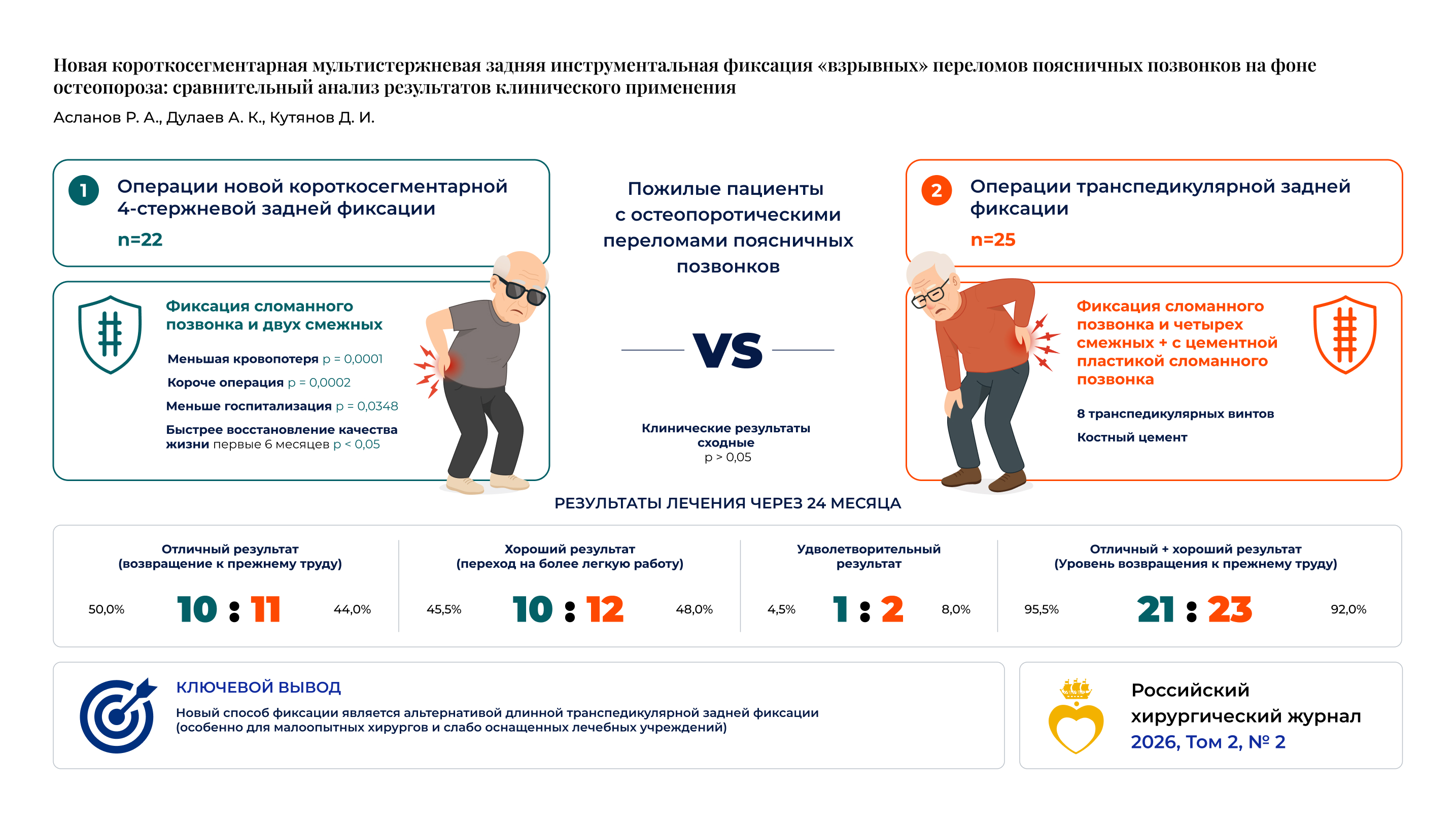
There is a need to improve technologies of posterior spinal fixation for osteoporotic fractures. To comparatively analyze the results of using the new method of short-segment multi-rod posterior instrumented fixation developed by the authors in patients with neurologically intact lumbar burst osteoporotic fractures (OF3 and OF4 according to the AO Spine-DGOU classification) relative to classical open long-segment pedicle screw instrumentation with bone cement vertebroplasty. The treatment outcomes of 47 patients were studied: first group (22 patients) – new short-segment multi-rod posterior fixation without cement augmentation of pedicle screws; second group (25 patients) – open pedicle eight-screw fixation without cement augmentation of screws, with vertebroplasty of the fractured vertebra using polymethyl methacrylate bone cement. Methods of nonparametric statistics were used. The advantages of the new fixation method stemmed from the lower extent and invasiveness of surgery, which was reflected in reduced blood loss (p = 0.0001), shorter surgical time (p = 0.0002), and shorter postoperative inpatient treatment (p = 0.0348), as well as in faster recovery of quality of life (p < 0.05) for at least six months after surgery. At 24 months after surgery, clinical and radiologic outcomes were similar (p > 0.05). The new fixation method can be considered a serious alternative to long-segment pedicle screw instrumentation in the presence of any barriers limiting the possibility of high-quality implementation of its minimally invasive percutaneous option, as well as of manipulations aimed at reconstruction of the fractured vertebral body under conditions of reduced bone mineral density.
The treatment of proximal femur fractures in elderly and senile patients remains one of the most pressing problems in modern traumatology and geriatrics. The high incidence of this pathology, the severe condition of patients characterized by polymorbidity, frailty, and cognitive impairment, as well as significant mortality rates, determine the medical and socioeconomic importance of the problem. This review, based on the analysis of domestic and foreign literature, examines the key aspects of PFF treatment in geriatric patients. A historical overview of the development of surgical approaches is presented. The role of conservative methods, which are currently used only as a forced alternative in strictly limited clinical situations, is analyzed in detail. Special attention is paid to the modern principles of preoperative preparation, based on early surgical intervention (within 48 h), comprehensive geriatric assessment, and a multidisciplinary approach. Modern surgical technologies for the treatment of trochanteric fractures and femoral neck fractures are discussed, including a differentiated approach to choosing the method of osteosynthesis or arthroplasty. A significant part is devoted to the analysis of intra- and postoperative complications, risk factors for their development, and prevention methods. The critical importance of early mobilization, nutritional support, and staged rehabilitation is emphasized. Promising directions for improving care are considered, including the development of the orthogeriatric approach, the creation of fracture liaison services, and the introduction of digital technologies.
Ischemic disorders of the shin are associated in most cases with the occurrence of local hypertensive ischemic syndrome. This syndrome, of mild to moderate severity, is quite difficult to diagnose, as it is masked by the clinical symptoms of the injury, but later characteristic complications may appear in the early period – infection of wounds, and later in the form of scar-fibrous tissue degeneration, delayed or non-healing of the fracture. The aim of the study was to determine the need for preventive fasciotomy in four shin cases during blocking intramedullary osteosynthesis in patients with fractured tibial diaphysis. In our studies, 93 patients with tibial diaphysis fractures were observed, 45 of them underwent semi-closed preventive fasciotomies from standard approaches for implantation of metal structures. We carried out monitoring of tissue pressure using the “Stryker” device. The pressure was determined at the following stages: before surgery, immediately after redrilling the bone marrow canal, after implantation of the metal structure, after fasciotomy followed by suturing the skin, 24 hours after surgery. During metallosteosynthesis of the tibia, a clinically significant increase in subfascial pressure is noted in the anterolateral and lateral compartments of the tibia. There is a slight change in subfascial pressure in the posterior surface and posterior deep compartments.
REVIEW
The monograph describes the activities of prominent representatives of the German surgical school of the second half of the 19th – early 20th century, who created modern surgery with their experiments, research and discoveries. It is accessible and fascinating to tell not only about scientific activities and discoveries of scientists, but also about their personal lives and hobbies. German surgery at the turn of the 19th and 20th centuries made a huge contribution to the development of surgical science. The discoveries and inventions made during this period determined the development of surgery for decades to come. One of the main achievements of this time was the birth of abdominal surgery. At the same time, new tools and treatment methods were invented. The development of radiology has allowed for more accurate diagnoses and effective treatment of patients. The progress of anesthesiology has made operations less painful and life-threatening for patients. The medical scientists described in this book undoubtedly form a single surgical school, the hallmark of which is the understanding that a surgeon must have diverse knowledge in the field of basic medical sciences.
HISTORY OF MEDICINE
RESULTS OF SURGICAL FORUMS

ISSN 3033-5604 (Online)