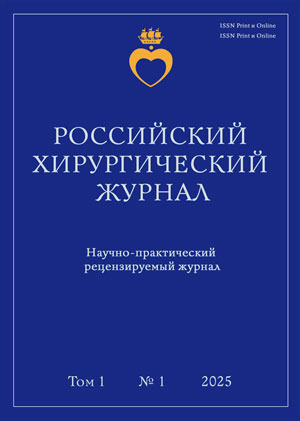
The Russian Surgical Journal is a scientific and practical publication covering the main sections of surgery oncology, traumatology, and orthopedics. It is intended for doctors of surgical specialties, teachers of higher medical educational institutions, employees of research institutes, managers, and specialists of municipal and departmental medical institutions. Students of the postgraduate education program for postgraduate students, residents, and students of medical universities. The journal publishes current materials on issues of surgery, oncology, traumatology, and orthopedics. The medical community, including first and foremost surgeons, will receive an additional source of information and the opportunity to publish their scientific data. In addition to original articles, the journal's website will include an electronic supplement in the form of the “International Surgical Digest.” The daily summary will be based on the most cited English-language journals in surgical specialties. Innovative and promising articles will be translated and presented in summary form in the journal supplement with a link to the main work.
The purpose of the journal is to provide information support for scientific developments in the form of publishing the results of scientific and practical research and achievements in the fields of surgery, oncology, traumatology, and orthopedics. It also aims to improve the professional training of surgeons and doctors of related specialties.
The objectives of the journal are to summarize scientific and practical achievements in the fields of surgery, oncology, traumatology, and orthopedics. The scientific concept of the publication involves the publication of modern achievements in the field of declared surgical specialties and the results of scientific national and international clinical studies. Both domestic and foreign scientists and doctors working in the indicated surgical areas are invited to publish in the journal.
The ambitious goal of the journal is to promote the development of medical science and to be interesting, useful, and necessary for the surgical community!
Current issue
HISTORY OF MEDICINE
The article highlights the medical career and contributions of Vladimir Ivanovich Dal (1801–1872) – a renowned Russian lexicographer and ethnographer, but less well known as a military physician. It presents details of his studies at the University of Dorpat, his service as an army doctor during the Russo-Turkish War (1828–1829) and the Polish campaign (1831), where he distinguished himself as a skilled surgeon and epidemiologist. His clinical observations, which anticipated the principles of antisepsis, as well as his accounts of epidemics, are examined. Particular attention is given to Dal’s works on medical education and folk medicine: his essay “A Physician’s Word to the Sick and the Healthy”, his study “On Folk Remedies” (1843), his interest in homeopathy, and his role in establishing a homeopathic clinic in Nizhny Novgorod. It is noted that Dal was among the first in Russia to describe the placebo effect and to advocate for the integration of scientific medicine with the proven practices of folk healers. His legacy reflects the rare union of practitioner, scholar, and educator, for whom words and healing were inseparable.
ОРИГИНАЛЬНЫЕ ИССЛЕДОВАНИЯ
In surgery, there are certain beliefs that have been passed down from generation to generation, from mentor to student, and have become deeply ingrained in practice, often existing outside the realm of rigorous clinical research. Over the past few decades, surgery has been plagued by numerous myths that have little to do with evidence-based medicine, but have become widely accepted as fact. However, in the 21st century, blindly following these myths without critical examination is not only unjustified but also potentially dangerous. In this article, we have examined several established myths in surgery from the perspective of current scientific data, in order to separate scientifically sound practices from established but outdated beliefs. This article is not an attempt to undermine authority or question the expertise of our great predecessors, but rather an attempt to engage in an honest and constructive dialogue for the sake of the ultimate goal of patient well-being.
The results of extrapleural thoracoplasty surgery (classical and using VATS – Video-Assisted Thoracoscopic Surgery) for destructive pulmonary tuberculosis in HIV patients (the main group consisted of 55 patients) were retrospectively analyzed. The data of destructive tuberculosis patients with HIV-negative status (57 patients) are presented as a control group, both groups are comparable in age and gender composition. VATS extrapleural thoracoplasty was performed noticeably in 25 % of patients in both groups – 12 (21.8 %) patients with destructive tuberculosis combined with HIV and 16 (28.1 %) patients without HIV infection. The volume and duration of the operation, blood loss, postoperative drainage, drainage-discharge, postoperative pain syndrome, and the progression of dyspnea were taken into account. An analysis of complications (intra- and postoperative) was performed. The terms of elimination (reduction by more than 2/3) of the cavity of destruction, resorption of foci of seeding, cessation (reduction in intensity) of bacterial excretion were estimated. HIV-Tuberculosis co-infected patients had a statistically significant more body weight deficit, were less married and had a permanent job. Drug addiction is common among this contingent, which caused frequent interruptions from treatment, with the development of XDR MBT. These patients were found to have a high incidence of chronic viral hepatitis and immunodeficiency. Data were obtained showing that the results of extrapleural thoracoplasty in both groups did not differ significantly. Complications were similar in frequency in both groups, were temporary, and remediable without the use of anesthesia; there were no deaths. VATS surgery reduced intraoperative complications. With continued anti-tuberculosis therapy after extrapleural thoracoplasty, a reduction in cavities was noted in 25 patients (45.5 %) one month after surgery and complete closure in 36 patients (65.5 %) 36 months after surgery. A decrease in bacterial excretion occurred in 35 patients (58.2 %), and 24 patients (43.6 %) were cleared of bacteria within the same timeframe. Extrapleural thoracoplasty doesn’t aggravate the course of HIV.
The formation of manual skills plays a critical role in the training of highly qualified specialists who are able to effectively perform surgical interventions. Classical anatomical education cannot fully ensure mass education of students, since biological material cannot be restored and is quickly damaged – digital three-dimensional models are devoid of these disadvantages. Three groups of students were formed: the experimental group, which studied theoretical material using the Pirogov interactive table and performed coronary artery bypass grafting on biological material, as well as using the “Working Heart” simulator; the control group, which studied theoretical material using the classical method and practiced manual skills on biological material without the use of the simulator; and the comparison group, which studied theoretical material using the Pirogov interactive table and performed coronary artery bypass grafting on biological material. To monitor the effectiveness of the educational process, entrance test conducted in all groups before the start of training. At the end of the classes on individual topics, the participants completed exit testing, as well as questionnaires. The depth of mastering the teaching methodology using 3D anatomical complexes and a biological simulator that simulates heart contractions to practice the elements of coronary bypass surgery increases significantly with the combined use of the developed computer programs, allowing students to increase their professional competencies. The obvious advantages of the original specialized training program for the surgical treatment of coronary heart disease are due to both the deep assimilation of theoretical material and our improved practical training.
Abdominal sepsis remains one of the leading causes of mortality in emergency surgery worldwide. The persistently high fatality rate is largely associated with diagnostic errors, organizational shortcomings, and inadequate management of surgical care. To identify the most frequent errors in providing surgical care to patients with abdominal sepsis and to improve a preventive checklist aimed at reducing these defects. A retrospective expert analysis of 502 medical records of patients diagnosed with abdominal sepsis who died in surgical departments of the Republic of Tatarstan between 2018 and 2022 was conducted. Statistical evaluation was performed using Student’s t-test, Pearson’s chi-square, and Fisher’s exact test (p < 0.05). The analysis revealed recurrent deficiencies in medical documentation (28.9–37.8 %), organizational management (26.5–44.2 %), diagnostic accuracy (26.3–95.0 %), and therapeutic processes (up to 85.8 %). Based on the findings, an updated 47-item checklist titled “Control List for Preventing Defects in Surgical Care for Abdominal Sepsis” was developed and implemented. The revised tool improves standardization of clinical procedures and enhances the quality of surgical practice in patients with abdominal sepsis.
Treatment of patients with acute ulcerative gastroduodenal bleeding is associated with certain difficulties. The introduction of X-ray endovascular occlusion of abdominal vessels in this life-threatening condition contributes to improving the quality of medical care, its effectiveness and safety. However, there is still no consensus among experts on the effectiveness of using this technology in the process of eliminating ulcerative bleeding in people of different ages. Objective: to evaluate the possibilities of using X-ray endovascular occlusion of abdominal vessels in the elimination of acute ulcerative gastroduodenal bleeding, taking into account the age characteristics of the patient's body. The effectiveness of eliminating acute gastroduodenal ulcerative bleeding in 2 557 patients from two large clinics in St. Petersburg was studied. The data analysis was carried out taking into account the age of the patients and the use of X-ray endovascular occlusion of the abdominal vessels in the therapeutic and diagnostic process. This technology was used in 194 cases in patients of the Alexander City Hospital (their age did not exceed 90 years), and in the treatment of 31 centenarians (patients aged 90+ years), specialists of the St. Petersburg Hospital for War Veterans reasonably refrained from this surgical technique. The efficiency index of endovascular interventions during the elimination of hemorrhages of ulcerative origin was 91.4 %, the total mortality parameter did not exceed 4.1 %. The initial endoscopic assessment of gastroduodenal ulcers complicated by bleeding in centenarians revealed a state of stable hemostasis in most cases (24 out of 31). In seven cases of centenarians with signs of hemostasis instability, a recurrence of bleeding from ulcers occurred in one (14.3 %) patient (re-eliminated without surgery). The desire to stop bleeding from gastric and duodenal ulcers in the process of providing medical care to patients of older age groups through purely minimally invasive methods (even based on the apparent impression of low-traumatic endovascular effects) should not prevail over the sense of special responsibility of specialists for the fate of centenarians due to their high risk of using any surgical technologies to achieve stable hemostasis.
Colorectal cancer remains a major oncological challenge. Surgical intervention is a cornerstone of radical treatment, and its progress is closely linked to the adoption and refinement of minimally invasive techniques. This review analyzes three key areas for improving colorectal cancer treatment outcomes: oncological, perioperative, and functional results. It traces the evolution from laparoscopy to robotic and transanal surgery, discussing the advantages and limitations of each method, including data from major randomized trials. Special attention is paid to strategies for reducing anastomotic leak rates, such as intraoperative perfusion assessment with indocyanine green, intracorporeal anastomosis, and minimized specimen extraction incisions. Modern organ-preserving approaches for rectal cancer are also highlighted. Future directions are associated with further miniaturization, the integration of artificial intelligence, smart instruments, and the personalization of surgical care.
Due to the development of screening programs, an increase in the detection rate of gastric cancer at early stages is being observed in the Russian Federation, which undoubtedly contributes to increased patient survival. In this context, the quality of life of patients after surgery becomes extremely relevant, serving as a prerequisite for the improvement and search for new surgical techniques in early-stage disease. In recent decades, there has been a trend towards an increase in the number of organ-preserving surgeries for gastric cancer. This article provides a review of global data on the technique of pylorus-preserving resection/gastrectomy, along with our own clinical observation. Undoubtedly, the pylorus performs critically important functions: it regulates the evacuation of gastric contents into the duodenum, prevents the rapid passage of undigested food and the reflux of bile back into the stomach. Removal of the pylorus during gastric resections is the main cause of such severe functional disorders as dumping syndrome and reflux. Modern studies have convincingly proven that for early gastric cancer (cT1N0, especially in the middle third of the stomach, without signs of lymph node involvement or subserosal invasion) and strict adherence to the principles of oncological radicality (adequate resection margins, D2 lymphadenectomy), pylorus-preserving resections provide equal 5-year overall and relapse-free survival rates compared to subtotal distal resections, while offering significant functional advantages, which is undoubtedly associated with an improved quality of life for patients.
Charcot spinal neuroarthropathy is a rare disease that is caused by post-traumatic disorders of proprioception and deep sensitivity, and is manifested by the formation of pseudoarthrosis and instability of the spinal motor segments below the site of its damage. The aim of the study was to study the features of the clinical course and methods of surgical treatment of spondylitis on the background of Сharcot spinal neuroarthropathy. Design is a small clinical series and literature review. The study included 10 clinical observations of patients with Сharcot spinal neuroarthropathy who were treated at the St. Petersburg Research Institute of Phthisiopulmonology of the Ministry of Health of the Russian Federation from 2014 to 2024. According to the results of bacteriological and histological examinations, the patients were divided into two groups. Group A included four patients with aseptic inflammation, and group B included 6 patients with purulent inflammation verified by histological examination. In 66.7 % of cases (4 patients) populations of S. Epidermidis-1, S. aureus-1, E. coli.-1, Prot. vulgaris-1 were detected in the crops of these patients. With timely surgical treatment, most patients, especially those with incomplete paraplegia, have a good short-term prognosis, however, in the long term, 30 % of patients undergo re-surgery due to the development of instability of the vertebral-motor segment, the formation of an adjacent level syndrome and/or the progression of the inflammatory process in the spine
In this article historical and medical analysis of the evolution of the treatment methods Hallux valgus. The main stages are traced: from early references in works of the XIII century, when treatment was reduced to radical exostoectomy and resection of the head of the metatarsal bone, until the establishment of principles of reconstructive surgery in the XX century. Special attention is given to the key turning points: introduction of X-ray for operations planning, development and improvement of various types of osteomyelitis (first chevron and SCARF, then proximal and circular), as well as transition to the concept of correction of all components of deformation. The current trend towards low-invasive percutaneous techniques has been noted. It was concluded that the history of HV treatment reflects the general evolution of surgery – from the gross elimination of consequences to the subtle restoration of anatomy and function.
HISTORY OF MEDICINE

ISSN 3033-5604 (Online)